Choosing the right grease for an excavator swing gear affects movement, noise, wear, and service life. This guide explains practical grease selection for swing bearings, pinions, and exposed gear teeth. It considers load, temperature, water exposure, dust, and the excavator manufacturer’s recommendations. A grease that works well on one machine may perform poorly on another.
How to grease an excavator swing gear properly? Begin with the service manual, not guesswork. Confirm the required grease type, NLGI grade, application points, and relubrication interval. Clean the grease fitting before connecting the gun. Dirt around the fitting can enter the bearing. Apply measured strokes while slowly rotating the upper structure, when the manufacturer permits this procedure. Watch for fresh grease appearing at the seal, but do not force excessive grease into the housing. Too much grease can increase heat and pressure.
Field experience shows that inspection matters as much as product choice. Listen for clicking, grinding, or uneven swing motion. Check for metallic particles, hardened grease, water contamination, and damaged seals. Record the date, grease brand, quantity, operating hours, and machine temperature. These details help technicians identify changes early. Yet, grease charts are not perfect for every worksite. Severe dust, marine moisture, and long idle periods may require revised maintenance intervals. This guide supports informed decisions, but the excavator manual and qualified technician remain the most reliable authorities. A clean fitting, correct grease, and careful observation often prevent expensive swing-system repairs. Small details matter.
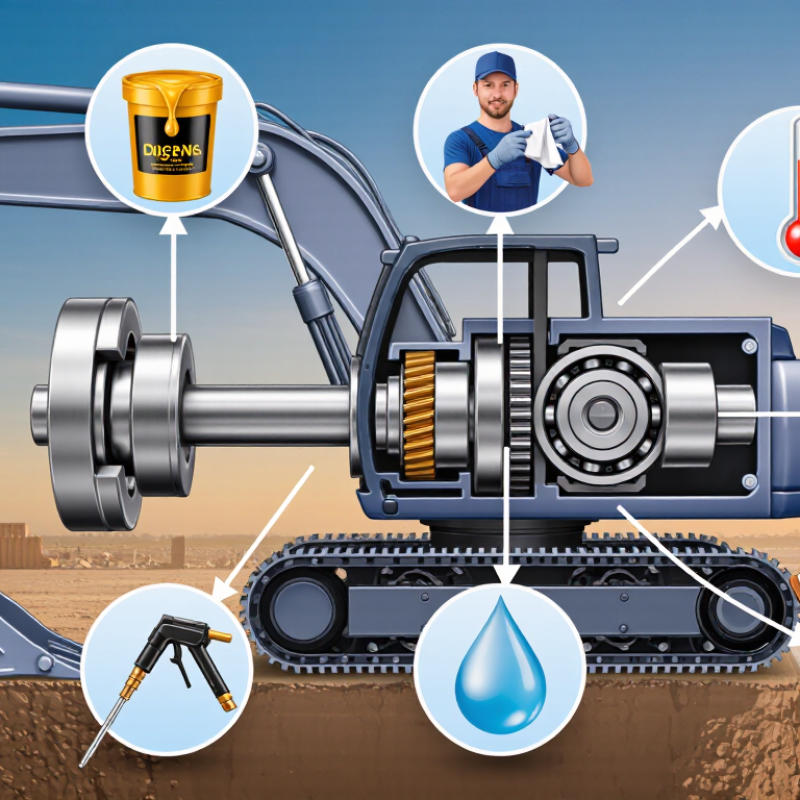
Excavator swing gear grease protects the large gear and pinion inside the upper structure. These parts transfer heavy torque while the machine rotates. Without suitable grease, metal surfaces can contact directly. Wear increases quickly. The grease forms a strong film between gear teeth. It also helps reduce friction, noise, rust, and heat during repeated slewing.
In field maintenance, I inspect the swing gear after washing away loose dirt. A clean surface makes cracks, pitting, and dry areas easier to notice. Grease should cover the tooth flanks evenly, not form thick lumps. Excess grease can collect dust and hide damage. That mistake is easy to make. Operators should follow the excavator’s service manual for grease type, quantity, and application intervals. Temperature, workload, water exposure, and operating hours all affect the interval. A machine working on muddy ground may need more frequent checks. I would not mix different grease types without confirming compatibility. Some mixtures soften, separate, or lose adhesion. During inspection, rotate the upper structure slowly and check several gear positions. One visible section cannot represent the whole ring. If teeth show sharp edges, deep scoring, or unusual metal particles, stop normal assumptions and arrange a qualified inspection. Grease cannot repair damaged gear teeth. It only supports proper contact and lubrication. In practice, maintenance records are useful, but they are not perfect; actual tooth condition should guide the next service decision.
| Data Dimension | Recommended Information | Purpose and Working Principle | Selection or Maintenance Check |
|---|---|---|---|
| Lubricated Component | Swing gear teeth, swing bearing raceway, or swing bearing rolling elements, according to the machine design | Grease forms a separating film between moving metal surfaces and reduces direct contact, friction, wear, and heat generation. | Confirm the excavator service manual before applying grease to a gear mesh or a bearing grease fitting. |
| Primary Function | Friction reduction, wear protection, corrosion protection, sealing, and contamination resistance | A suitable grease remains in the lubrication zone longer than a low-viscosity oil and helps protect the component during intermittent and shock-loaded operation. | Use a grease intended for heavy-load industrial or mobile-equipment applications. |
| Typical Consistency | NLGI Grade 1 or NLGI Grade 2 | NLGI 1 is softer and flows more easily at lower temperatures. NLGI 2 is firmer and commonly used where retention and ambient temperatures permit. | Choose the grade specified by the equipment manufacturer and consider the lowest expected operating temperature. |
| Load-Carrying Performance | Extreme-pressure or heavy-load performance; commonly evaluated by four-ball weld-load and wear testing | Extreme-pressure additives help protect gear teeth and rolling contacts when high loads, start-stop motion, or shock loading temporarily squeeze out the normal lubricant film. | Do not select grease solely by the words “EP” or “heavy duty”; review the technical data sheet and application compatibility. |
| Base Oil Viscosity | Often selected in a medium-to-high industrial viscosity range; the exact value depends on load, speed, and temperature | Higher base-oil viscosity generally supports heavier loads and slower movement, while lower viscosity can improve cold-start flow and pumpability. | For slow, heavily loaded swing mechanisms, prioritize load capacity without sacrificing low-temperature delivery. |
| Thickener Types | Lithium complex, calcium sulfonate complex, or another approved heavy-duty thickener system | The thickener holds the base oil in place and influences water resistance, temperature performance, mechanical stability, and compatibility. | Avoid mixing different thickener systems unless compatibility has been confirmed by the grease supplier or equipment manufacturer. |
| Temperature Capability | Select a product whose published operating range covers the actual ambient and component temperatures | Excessive heat accelerates oxidation and softening, while low temperatures increase stiffness and may prevent proper delivery through grease lines. | Check dropping point, low-temperature torque or pumpability data, and the supplier’s stated service-temperature limits. |
| Water Resistance | Good to excellent water washout and corrosion resistance for wet, muddy, or high-pressure cleaning conditions | Water-resistant grease helps maintain film strength and reduces rust on exposed gear teeth and bearing surfaces. | After water ingress or pressure washing, inspect the grease condition and relubricate only as required by the service procedure. |
| Adhesion and Retention | Strong adhesion with resistance to sling-off, squeeze-out, and mechanical displacement | The swing mechanism operates with repeated rotation and vibration; adhesive properties help keep lubricant on the contact surfaces. | A grease that is too soft may migrate or sling off, while one that is too stiff may not distribute correctly. |
| Open Gear Application | Use an open-gear grease only when the swing gear design and service manual call for it | Open-gear products are formulated to adhere to exposed tooth surfaces and protect against high loads, dust, and moisture. | Do not substitute a general chassis grease for an approved open-gear lubricant when the gear manufacturer requires a specialized product. |
| Lubrication Method | Manual grease gun, centralized lubrication system, or controlled brushing/spraying for exposed gear teeth | The application method must deliver enough grease to the working surfaces without forcing contaminants into seals or overfilling the bearing cavity. | Clean the fitting or gear surface before application and use a dedicated, contamination-free grease gun. |
| Application Amount | Follow the machine manufacturer’s quantity and interval; avoid filling by appearance alone | Under-greasing can cause metal-to-metal contact, while over-greasing can increase churning, heat, seal pressure, and leakage. | Apply small measured amounts at the specified intervals and rotate the upper structure if the service procedure requires distribution. |
| Typical Service Interval | Defined by operating hours, duty severity, contamination, and the equipment manual | Heavy digging, high swing cycles, water exposure, abrasive dust, and high temperatures can shorten the required relubrication interval. | Use the shortest applicable interval for severe service and record lubrication dates and operating hours. |
| Compatibility | Must be confirmed before changing product, thickener, base oil, or additive system | Incompatible greases may soften, harden, separate, lose adhesion, or reduce corrosion and load protection. | When compatibility is unknown, remove as much of the old grease as practical and follow the supplier’s changeover procedure. |
| Contamination Control | Keep grease, fittings, tools, and storage containers clean and sealed | Dust, sand, water, and metal particles act as abrasives and can accelerate wear in gear teeth, raceways, and rolling elements. | Wipe fittings before connection, replace damaged dust caps, and store grease away from heat, water, and direct sunlight. |
| Inspection Indicators | Abnormal noise, increased backlash, rough rotation, high temperature, leakage, pitting, or visible metal particles | These signs may indicate insufficient lubrication, contamination, misalignment, seal damage, excessive load, or component wear. | Stop and investigate abnormal symptoms; grease alone cannot correct damaged gears, bearings, seals, or incorrect clearances. |
| Storage Life | Use the manufacturer’s stated shelf life and first-in, first-out stock rotation | Extended storage, temperature cycling, and moisture exposure can cause oil separation, oxidation, or contamination. | Keep containers closed, upright, labeled, and stored under the conditions listed on the technical data sheet. |
| Important Note | Grease selection and lubrication intervals must follow the excavator, swing-bearing, and swing-gear manufacturer’s specifications. The values above are general engineering guidance and should not replace the equipment service manual or a verified lubricant compatibility assessment. | ||
It forms a protective film between the large gear and pinion. This reduces friction, noise, heat, rust, and tooth wear. Grease cannot heal teeth.
Park on firm, level ground and lower the attachment safely. Stop the engine, remove the key, and release stored hydraulic pressure. Clean the cover and fittings before applying grease.
Follow the equipment manual for the specified quantity. Pump slowly through a clean grease gun. Excess grease may collect soil and create abrasive paste.
Check the service interval in the manual. Mud, water, heavy workloads, high temperatures, and long operating hours may require more frequent inspections. Do not guess.
Inspect the gear teeth, pinion, seals, bolts, and visible grease. Look for cracks, pitting, metal dust, water, dry areas, or unusually hard grease. Small errors matter.
Do not mix them without confirming compatibility. Some mixtures may soften, separate, or lose adhesion. Checking the product information is safer than assuming compatibility.
Rotate the upper structure slightly only when the manual permits it. Check several gear positions, not just one exposed section. Keep hands away from moving parts.
Stop normal operation assumptions and arrange a qualified inspection. Sharp edges, deep scoring, or unusual particles may indicate serious wear. Grease only supports proper lubrication.
Record the date, grease type, and amount applied. Recheck for leaks after operation and inspect the teeth after several working hours. Records help, but actual tooth condition matters more.
Choosing the right grease is essential for keeping an excavator swing gear, bearings, and sealing surfaces protected under heavy loads, slow rotation, vibration, and changing temperatures. This guide explains how swing gear grease works, how to match grease characteristics to different swing systems, and which specifications matter most, including load resistance, water protection, adhesion, temperature stability, and compatibility with existing lubricant. It also answers the practical question: How to grease an excavator swing gear properly?
The recommended process includes cleaning the fitting and surrounding area, checking the manufacturer’s lubrication points, applying the correct amount gradually, and avoiding excessive pressure or over-greasing. Regular maintenance should follow operating conditions rather than relying only on a fixed calendar. Operators should inspect for noise, backlash, heat, leakage, contamination, uneven grease distribution, and abnormal wear. Common errors include using incompatible grease, neglecting cleaning, applying too much or too little lubricant, and ignoring early warning signs. A consistent inspection and lubrication routine can improve service life, reduce friction, and support reliable excavator performance.

 Plautz Excavator